
March 1, 2026
3 minutes

August 18, 2026
10–11 minutes

At first glance, stablecoins appear to present a straightforward challenge to banks.
A dollar-denominated asset can sit inside a digital wallet. It can move across a blockchain at almost any hour. Businesses can use it to transfer value across borders. Financial applications can incorporate payments directly into software.
Much of that activity can occur without the customer opening another bank account, initiating a wire transfer, or interacting directly with a conventional payment network.
Viewed from the front end, the story looks like disintermediation. Look underneath the transaction, however, and the picture becomes more complicated.
Stablecoin issuers need somewhere to hold reserves. Dollars still have to enter and leave the digital ecosystem. Treasury assets need to be purchased and safeguarded. Redemptions need to be funded. Compliance systems need to operate. Businesses need connections between stablecoins and existing accounts. Institutional customers need custody, liquidity, reporting, and reliable conversion between blockchain-based money and conventional money.
Banks can participate in many of those functions. That means one of the most important stories in stablecoin adoption may be almost invisible to the end user.
Stablecoins could change the role banks play in payments without removing banks from the infrastructure.
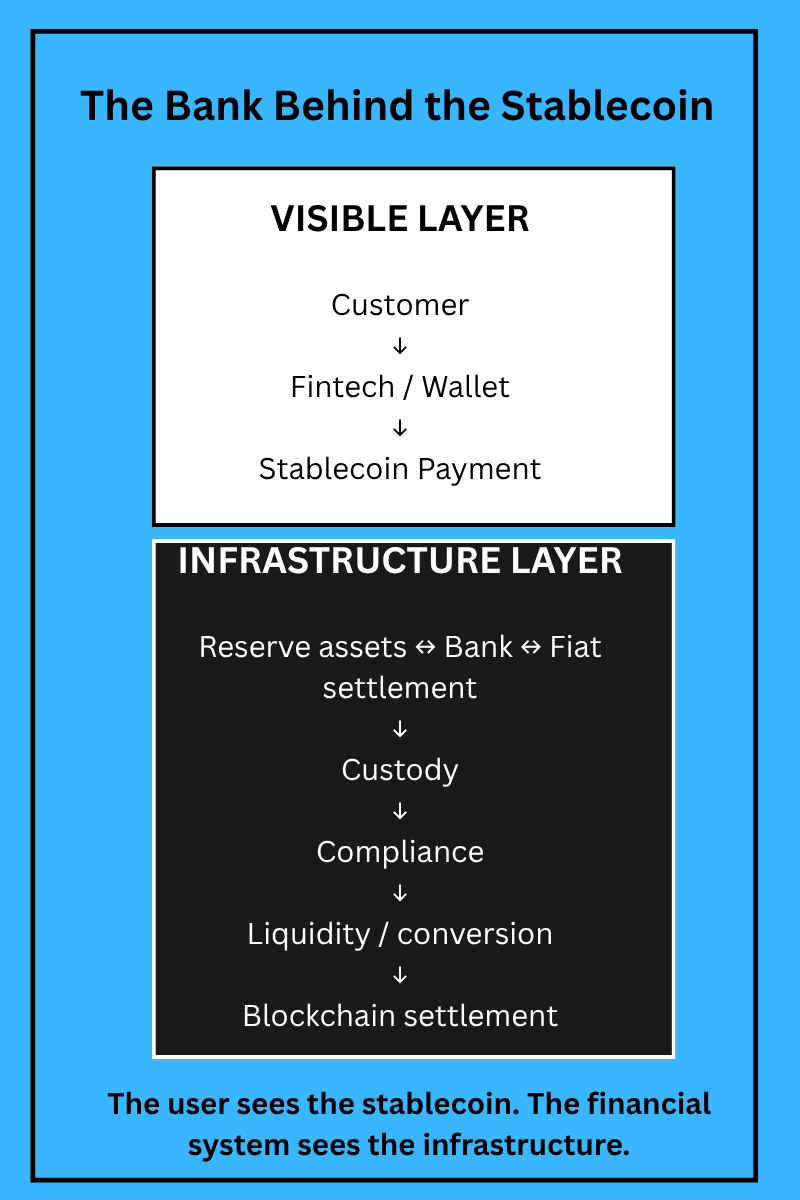
The stablecoin may be visible to the customer. The bank may be invisible behind it.
A stablecoin can move over a blockchain without a bank processing each individual transaction. That is one of its defining features. But issuing, redeeming, distributing, and managing a fiat-backed stablecoin still requires connections to the conventional financial system.
Consider what has to happen around the token.
Federal Reserve research describes a stablecoin ecosystem increasingly characterized by partnerships among issuers, financial institutions, wallets, payments firms, trading platforms, and other intermediaries.1
That matters because stablecoins do not create an entirely separate monetary system. They create a new interface with the existing one. And interfaces are often where financial institutions become strategically important.2
The relationship between banks and stablecoins is often reduced to a single question: Will stablecoins take deposits away from banks?
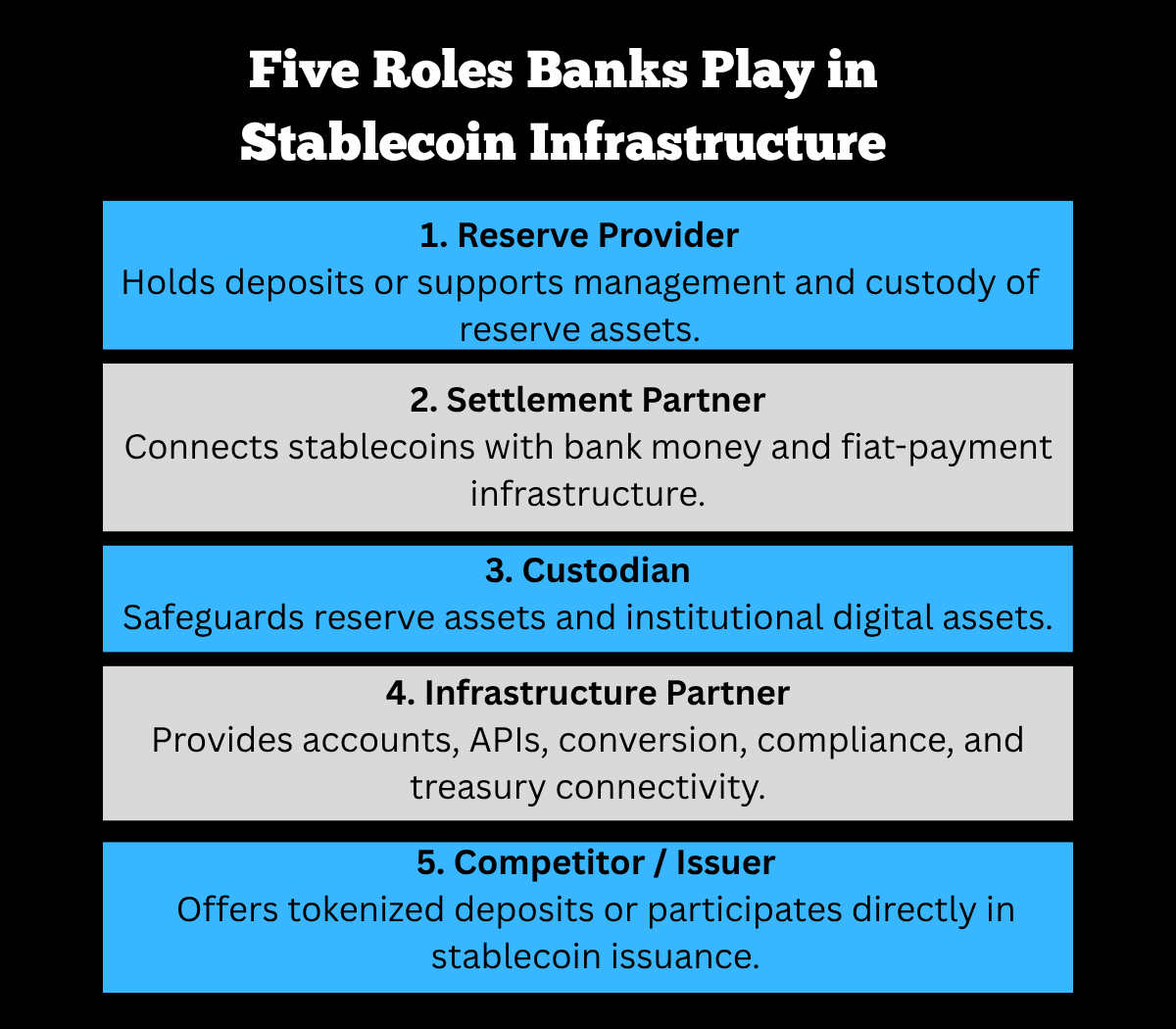
That question matters. But it is only one side of the relationship. Banks can participate in the stablecoin ecosystem in at least five distinct ways.
The most basic role sits behind the stablecoin itself. Fiat-backed stablecoins require reserve assets capable of supporting redemption.
Under the U.S. regulatory framework established by the GENIUS Act, eligible reserve assets for payment stablecoins include highly liquid assets such as deposits at depository institutions and short-term U.S. Treasury securities.3
That creates a role for banks even when the bank does not issue the stablecoin.
An issuer may maintain cash deposits with banking institutions while holding other portions of its reserves in Treasury securities or other permitted assets. Banks can therefore become part of the reserve infrastructure supporting a stablecoin circulating elsewhere.
The customer sees a digital dollar. Behind it may sit deposits, Treasury assets, custodial arrangements, and regulated financial institutions. This is an important example of how digital assets can change the visible layer of finance while preserving—and sometimes increasing—the importance of infrastructure underneath it.
Stablecoins also need bridges to conventional money.
A blockchain can transfer tokens, but businesses still operate within an economy in which salaries, taxes, invoices, securities transactions, corporate treasury balances, and consumer spending frequently involve conventional bank money. That creates demand for conversion.
Dollars move into stablecoins. Stablecoins move back into dollars.
Businesses need stablecoin receipts converted into bank balances. Institutional users may need liquidity across both environments.
Banks can provide accounts and settlement capabilities that connect these systems.
This role may become particularly important in cross-border transactions.
Stablecoins can potentially reduce some of the frictions associated with correspondent banking arrangements, particularly where moving dollar-denominated value across jurisdictions is slow or expensive. Federal Reserve researchers have examined stablecoins as a potential alternative rail for some cross-border payments while also emphasizing that conversion between stablecoins and fiat money remains an important part of the ecosystem.4
Stablecoin transactions may therefore bypass one part of traditional payment infrastructure while creating demand for banking services at the points where the two systems meet.
That is not complete disintermediation. It is a change in where intermediation occurs.
Banks can also participate as custodians. There are really two custody questions.
The first concerns stablecoin reserves. Cash, Treasury securities, and other reserve assets need institutional safekeeping.
The second concerns digital assets themselves. Banks increasingly have regulatory pathways to provide crypto-asset custody and safekeeping services, allowing them to support institutional customers that need to hold stablecoins or other tokenized assets.
The distinction matters.
Stablecoins may move on decentralized or public networks, but institutional participation frequently requires trusted control layers around keys, permissions, compliance, accounting, and operational risk. That puts custody directly inside the stablecoin infrastructure.5
The result is another apparent contradiction: A technology designed to allow assets to move without relying on a conventional intermediary can still generate demand for institutional intermediaries capable of safeguarding those assets.
Banks do not necessarily need to issue their own stablecoin to participate economically. They can provide infrastructure.
A bank might connect an issuer to payment accounts. It might support fiat conversion. It could provide custody or reserve services.It might integrate stablecoin transactions into corporate treasury products. It could provide APIs that allow fintechs and businesses to move between bank deposits and blockchain-based money. It may even provide services underneath another company's customer-facing product.
Federal Reserve researchers studying how banks historically responded to financial innovations argue that banks tend to adapt rather than passively accept disintermediation. Their 2026 analysis identifies potential bank responses to stablecoins including partnerships, reserve-related services, digital-asset custody, tokenized deposits, and other forms of infrastructure participation.6
This may become one of the most consequential bank strategies. The consumer does not necessarily need to know that a bank is involved. A fintech could own the interface. A stablecoin issuer could own the brand. A blockchain could process the transaction. The bank could still provide essential infrastructure behind all three.
Stablecoin expansion may shift banks away from owning every customer interface and toward owning critical parts of the infrastructure behind it.
Banks can also compete with stablecoins. One of the most important alternatives is the tokenized deposit.
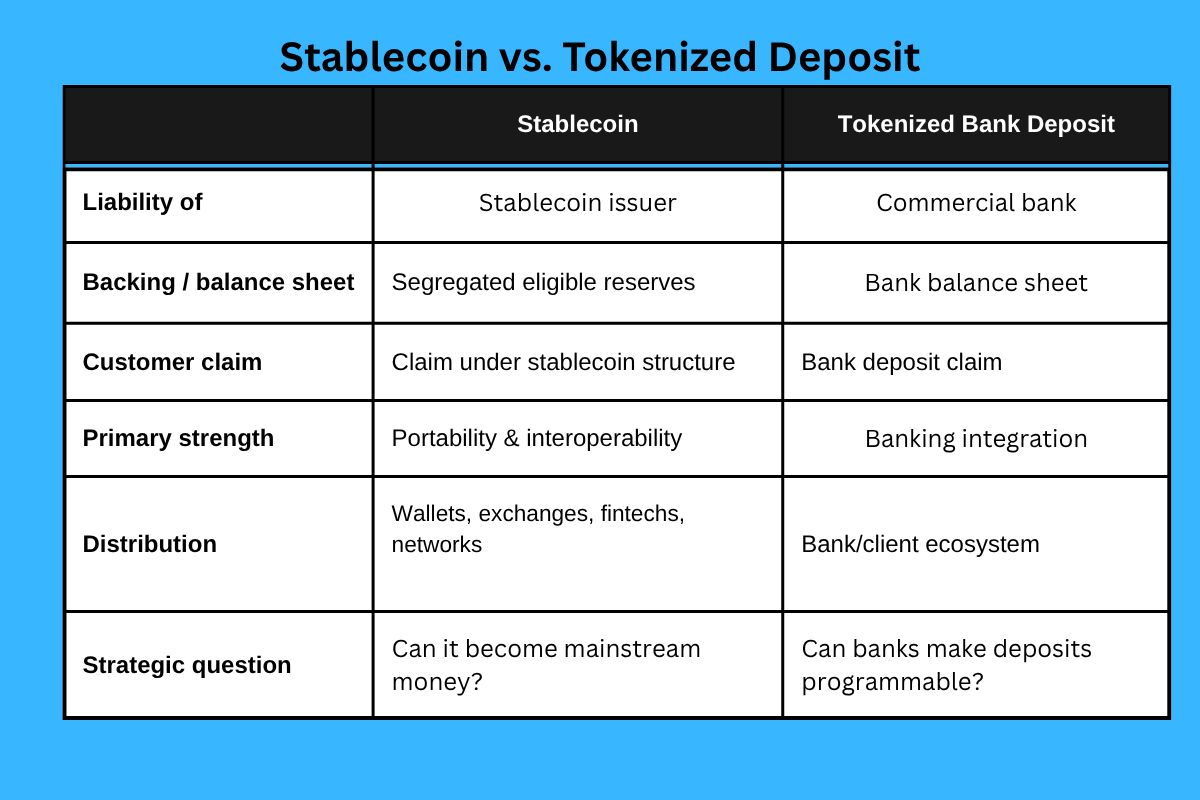
A stablecoin and a tokenized bank deposit may look similar at the user-interface level. Both can represent dollar-denominated value on programmable infrastructure. But economically and legally, they are different.
A stablecoin is generally a claim structured around the stablecoin issuer and its reserve arrangement. A tokenized deposit remains a deposit liability of a commercial bank. That difference has strategic consequences.
If customers move bank deposits into third-party stablecoins, banks can potentially lose part of their traditional funding base and customer relationship. If banks instead offer programmable versions of deposits, they may be able to provide some of the technological advantages associated with blockchain-based money while preserving the deposit inside the banking system.
U.S. regulators are increasingly dealing explicitly with that distinction. In its April 2026 proposed implementation of the GENIUS Act, the FDIC stated that deposit-insurance treatment of a bank deposit does not depend on the technology or recordkeeping system used to represent that deposit—an important principle for tokenized deposits.7
Federal Reserve research also suggests that banks are actively considering tokenized deposits among their responses to stablecoin growth.8 That creates the possibility that the future of programmable money will not be stablecoins or banks. It may involve competition among several forms of digital money operating across increasingly connected infrastructure.
None of this means stablecoins are harmless to banks. The challenge is real.
Deposits are not merely money sitting in customer accounts. They are an important source of funding that banks use to support lending and other balance-sheet activity. If a customer moves $10,000 from a bank deposit into a stablecoin, where that money ultimately lands matters. If the stablecoin issuer deposits the same money back into the banking system, the aggregate quantity of bank deposits may change relatively little. But their composition can change.
Instead of many retail customers maintaining relatively stable deposits across banks, a larger pool of funds might become concentrated in accounts associated with stablecoin issuers or other wholesale entities. If reserves move outside bank deposits and into Treasury securities or other eligible assets, more funding may leave bank balance sheets.
Federal Reserve analysis has emphasized precisely this point: the effect of stablecoin growth on bank deposits and credit depends heavily on how reserve assets are structured and how funds recycle through the financial system.9
That means the bank-stablecoin relationship contains both opportunity and threat. Banks can earn fees from custody, settlement, reserve servicing, infrastructure, and payments. At the same time, stablecoins can compete for transaction balances and potentially change the composition, stability, and cost of bank funding.
Those effects will not be identical for every institution. A large global bank with custody operations, sophisticated treasury infrastructure, and technology partnerships may find significant opportunities. A smaller institution dependent heavily on conventional deposits may see a different balance of risks and rewards.
Stablecoin adoption therefore does not produce a single outcome called “bank disintermediation.” It changes the competitive structure of banking.
This distinction deserves particular attention because it may shape the institutional architecture of digital money.
But they begin from different institutional foundations.
The holder relies on the stablecoin issuer and the reserve structure supporting redemption.
The token can potentially circulate broadly across wallets, trading platforms, blockchains, and applications.
That gives stablecoins an important advantage in distribution and interoperability.
The holder has a deposit claim on a bank.
The bank retains the customer relationship and the associated deposit liability.
That gives tokenized deposits a natural connection to existing banking, compliance, credit, and treasury infrastructure.
The strategic question is whether these systems converge, compete, or specialize.
Stablecoins may prove especially powerful for open digital networks, cross-platform transfers, payments, trading, and cross-border use.
Tokenized deposits may become attractive for institutional and corporate environments where users already maintain banking relationships and value integration with existing financial systems. Neither model necessarily eliminates the other. The future monetary stack may be plural.
The regulatory environment reinforces this convergence. The GENIUS Act, enacted in July 2025, created a federal framework for payment stablecoins in the United States. Regulators have since been developing rules around reserves, redemption, capital, risk management, custody, anti-money-laundering requirements, sanctions compliance, and permitted issuer activities.10,11 This matters strategically.
Stablecoins are moving from a market largely defined by crypto-native infrastructure toward one in which regulated financial institutions can participate under increasingly explicit rules. Banks can potentially become issuers, reserve institutions, custodians, settlement providers, or service providers to regulated stablecoin companies. At the same time, compliance requirements become increasingly embedded within the infrastructure.
The FDIC's 2026 proposed rules, for example, explicitly address Bank Secrecy Act and sanctions-compliance requirements for FDIC-supervised permitted payment stablecoin issuers.12
That reinforces a broader Blocks & Bonds argument: Compliance is not simply something imposed on digital financial infrastructure after the fact. At institutional scale, compliance becomes part of the infrastructure itself.13
This leads to the most interesting possibility.
Banks may play a growing role in stablecoin markets while becoming less visible to the person actually using the stablecoin.
Imagine a company using a fintech application to pay a supplier overseas.
The company sees its account dashboard.
It chooses a dollar amount.
The supplier receives dollar-denominated value quickly.
From the user's perspective, the transaction may appear to involve only the fintech and a stablecoin.
Behind that experience could sit:
The user does not need to understand any of this.In fact, successful infrastructure often becomes most valuable when users stop noticing it. That is what makes the role of banks easy to underestimate.
Banks do not necessarily need their logos on the stablecoin. They need to control or participate in functions that the system cannot operate efficiently without.
This also changes how investors and operators should think about value accrual.
Stablecoin growth does not mean all of the resulting economics accrue to the stablecoin issuer.
Value can flow to:
The stablecoin issuer may capture reserve income.
The blockchain may capture transaction fees.
The wallet may own the customer relationship.
The bank may earn custody or settlement revenue.
The payment company may own merchant distribution.
This is precisely why Where Value Accrues in the Crypto Stack matters.
Technology adoption and economic capture are separate questions. If stablecoins become a major payment and settlement rail, some of the largest beneficiaries may be companies that users barely know are participating.
The important signal is no longer simply whether another bank announces a stablecoin pilot.The next stage will be visible in recurring activity.
Those developments will tell us whether stablecoins are creating a separate financial system or becoming another layer of the existing one. The likely answer may be somewhere between the two.
The disruptive story is easy to understand. Stablecoins move money outside conventional payment rails. Banks lose deposits. Blockchain replaces financial intermediaries. A new system displaces the old one.
Parts of that story may prove correct. But infrastructure transitions rarely happen so neatly. New systems connect with old ones. Incumbents adapt. Functions migrate. Some intermediaries disappear while others become more important. New companies capture customer relationships while established institutions provide infrastructure behind the scenes.
Stablecoins may ultimately transform how dollars move.
But none of that requires banks to disappear.
The more interesting question is therefore not whether stablecoins will replace banks. It is which banking functions remain indispensable as money becomes programmable—and which institutions successfully adapt to provide them. That is the quieter stablecoin story. It may also prove to be the more important one.
Stablecoins, tokenization, and custody are beginning to converge into a broader institutional infrastructure stack.
To understand the framework connecting them, read: The Blocks & Bonds Thesis: From Crypto Narratives to Financial Infrastructure